Ceiling drywall takes more abuse than walls because gravity never stops pulling. From sagging panels to persistent cracks, here are the problems and their professional solutions.
Why Ceilings Are More Vulnerable Than Walls
Gravity is the fundamental difference between ceiling and wall drywall. A wall panel rests on the bottom plate and is supported along its edges by studs, so gravity actually helps hold it in place. A ceiling panel, by contrast, fights gravity every second of every day. The weight of the gypsum, joint compound, texture, and paint all pull downward, and the only things holding the panel up are the screws or nails attaching it to the joists above. Over time, this constant downward force can cause fasteners to loosen, joints to crack, and entire panels to sag. The problem is compounded in older homes where ceiling drywall may have been attached with nails rather than screws, and in homes where the attic above generates significant heat, accelerating the drying and weakening of the joint compound.
Sagging Ceiling Panels: Causes and Fixes
A sagging ceiling is more than an eyesore — it can indicate a structural problem that will worsen over time. The most common cause is insufficient fastening: if the original installer used too few screws or nails, or if they missed the joists entirely, the panel will eventually pull away and bow downward. Water damage from a roof leak or bathroom above is another frequent culprit, as saturated gypsum is significantly heavier than dry drywall and the added weight can overwhelm the remaining fasteners. In [Atlanta](/locations/georgia/atlanta), where summer thunderstorms and aging roofs are a common combination, ceiling sag from water intrusion is one of the most frequent repair requests we receive. The fix depends on severity: minor sags can sometimes be re-secured by adding screws into the joists and re-taping the affected joints, while severely damaged panels need to be removed and replaced entirely.
Ceiling Cracks Along Joints and Corners
Cracks along ceiling joints typically indicate movement in the structure above — seasonal expansion and contraction of roof trusses is a well-documented cause known as truss uplift. As the top chords of the trusses absorb moisture and expand in winter, they lift the center of the ceiling slightly, creating cracks where the ceiling meets interior partition walls. This is not a structural concern, but it is unsightly and frustrating because the cracks tend to reappear after repair if the underlying movement is not accommodated. The professional solution is to install crown molding or a floating corner detail at the wall-ceiling junction, which allows the ceiling to move independently without cracking. For cracks in the field of the ceiling, re-taping with fiberglass mesh and flexible compound typically provides a durable fix. Homeowners in [Savannah](/locations/georgia/savannah) often experience this issue due to the region's high humidity swings between seasons.
Nail Pops and Fastener Failures in Ceilings
Nail pops are small circular bumps or craters that appear when a fastener backs out of the joist and pushes through the surface of the drywall. They are especially common in ceilings because the constant pull of gravity works to loosen nails over time. The standard repair involves driving a new drywall screw about two inches from the popped nail, then removing the old nail and filling both holes with joint compound. If nail pops are widespread, it may indicate that the original installation used nails that were too short or that the joists have dried and shrunk since construction. In that case, adding screws every eight inches along each joist — a process called re-securing — will prevent future pops and stabilize the entire ceiling.
Water Stains and Damage on Ceiling Drywall
Brown or yellow stains on a ceiling almost always mean water has found its way in from above. Before repairing the drywall, you must find and fix the source of the water — otherwise the stain will return and the damage will worsen. Common sources include roof leaks, condensation on HVAC ducts, overflowing toilets or tubs on the floor above, and improperly sealed plumbing vent boots. Once the source is resolved and the area is completely dry, minor stains can be sealed with a stain-blocking primer and repainted. If the drywall is soft, crumbling, or shows any sign of mold, the affected section must be cut out and replaced. Our [drywall repair](/services/drywall-repair) team in [Augusta](/locations/georgia/augusta) and [Columbus](/locations/georgia/columbus) handles ceiling water damage repairs daily, including coordination with roofers and plumbers when needed.
Popcorn Ceiling Issues and Modern Alternatives
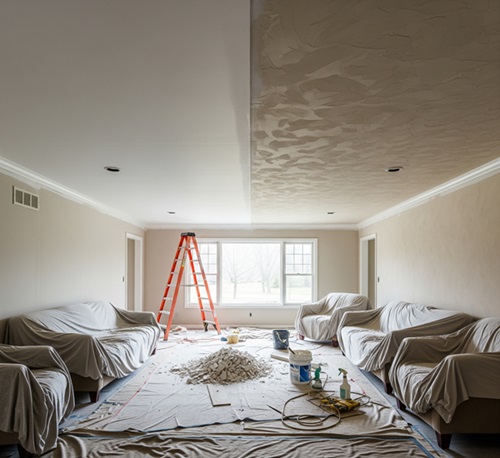
Popcorn ceilings, popular from the 1950s through the 1980s, present unique repair challenges. The texture is brittle and nearly impossible to patch invisibly — even a small repair tends to stand out because the texture pattern cannot be precisely replicated. For this reason, many homeowners opt to remove the popcorn texture entirely and replace it with a modern smooth or light knockdown finish. If the popcorn was applied before 1980, it should be tested for asbestos before any work begins. Removal involves wetting the texture with a garden sprayer, scraping it off with a wide drywall knife, and then skim-coating the ceiling to create a smooth surface. It is messy, time-consuming work, but the transformation is dramatic.
Hiring a Professional for Ceiling Drywall Work
Ceiling work is harder than wall work by every measure — it requires overhead lifting, scaffolding or stilts, and precise fastening into joists that may not be visible from below. Working overhead also generates significant fatigue, which leads to mistakes. For these reasons, ceiling drywall repair is one of the services most frequently delegated to professionals rather than attempted as a DIY project. Homeowners throughout Georgia, from [Marietta](/locations/georgia/marietta) to [Atlanta](/locations/georgia/atlanta), rely on our experienced crews for everything from single nail-pop fixes to complete ceiling replacements. We provide free estimates and can typically begin work within a few days of your initial call.
Need Professional Drywall Help?
Contact Fast Fix Drywall Repair for a free estimate on your next project.
Get a Free QuoteLooking for drywall repair services in your area? Browse our full service directory by city.