Removing cabinets and built-ins almost always leaves drywall damage behind. This guide covers patching, refinishing, and integrating repairs into the surrounding wall.
Why Cabinet and Built-In Removal Damages Drywall
When kitchen cabinets, built-in bookshelves, or custom wall units come down, the wall behind them is rarely in usable condition. Cabinets are usually installed with long screws driven directly into studs, sometimes with construction adhesive added for extra hold. Built-ins often have brackets, ledger boards, or scribed trim that's attached to the wall in multiple locations. Wall-mounted shelves use heavy-duty anchors that crush drywall when pulled out. By the time the unit is off the wall, you're looking at dozens of screw holes, large patches of damaged paper from adhesive removal, and possibly unpainted areas if the cabinet was installed before the room was painted. The repair scope depends on what was removed and how. A simple shelf might leave a few anchor holes. A full kitchen cabinet system might leave a wall that's essentially destroyed and needs to be skim coated from end to end. Whether you're updating a <a href="/locations/california/long-beach">Long Beach</a> bungalow kitchen or repurposing a study in a <a href="/locations/florida/saint-petersburg">Saint Petersburg</a> townhouse, our <a href="/services/drywall-repair">drywall repair team</a> handles cabinet and built-in removal damage every week.
Assessing the Damage After Removal
Before starting repairs, fully clear the area and assess what you're dealing with. **Damage categories to inventory:** - **Screw and bolt holes.** Count them. Kitchen cabinet installations might have 50+ mounting screws across an entire wall. - **Adhesive damage.** Look for areas where the paper face was torn off when cabinets were pulled away from adhesive. These are the worst damage points and need the most work. - **Anchor holes.** Bigger than screw holes and often with crushed gypsum around the opening. - **Unpainted areas.** If the cabinets went up before the room was painted, the wall behind them may be primer-only, raw drywall, or a different paint color. - **Texture differences.** Cabinets often masked walls that have texture variations from old repairs or different drywall material. - **Trim and molding gaps.** Removing baseboards or crown molding to take out built-ins leaves gaps and damage at the wall edges. Photograph everything before starting. The photos help when planning the repair sequence and serve as a "before" record for personal satisfaction (or insurance documentation, if relevant).
Removing Adhesive and Preparing the Surface
Construction adhesive is the biggest challenge after cabinet removal. Old adhesive bonded to drywall paper for years can rip off paper layers, gypsum chunks, or both when removed. **Adhesive removal process:** 1. **Heat the adhesive** with a heat gun on low setting (or hair dryer for small areas). Softer adhesive scrapes more cleanly. 2. **Scrape with a wide putty knife** held at a low angle to avoid digging into the drywall. 3. **Use citrus-based adhesive remover** (Goo Gone Pro, Goof Off) for stubborn residue. Apply, wait 5 minutes, scrape. 4. **Wipe with clean rag** to remove dissolved residue and chemical traces. 5. **Let the wall dry completely** before any repair work begins. **For damaged paper face:** - **Trim loose paper** with a utility knife back to solid material. - **Stabilize remaining edges** with shellac-based primer (Zinsser BIN) to prevent further peeling and to provide a hard surface for joint compound to bond to. - **Do not attempt to compound over loose paper** — it always fails. For large adhesive contamination areas, sometimes it's faster to cut out the damaged drywall and patch with a fresh section than to try to clean and stabilize the existing material.
Patching Screw Holes and Small Damage
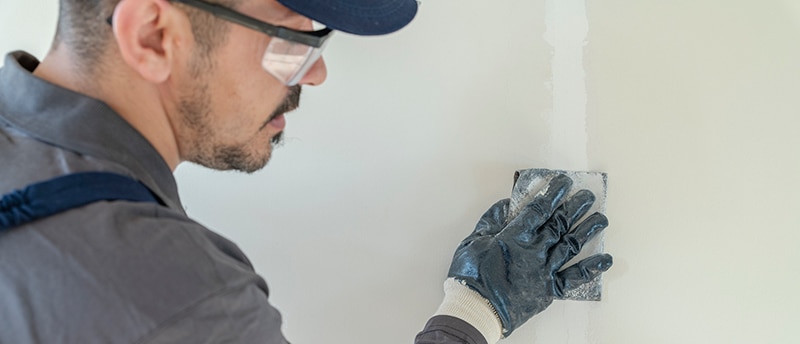
For walls with mostly small screw holes and minor damage, individual patching is faster than skim coating. **Efficient batch repair process:** 1. **Mark each hole** with painter's tape to track progress. 2. **Mix setting-type joint compound** (Easy Sand 20 or 45) — it shrinks less than premixed and sets in usable time. 3. **Press compound firmly into each hole** with a 4-inch knife, working in two directions to ensure full filling. 4. **Knife flush** with the wall surface in a single sweeping pass. 5. **Let set** for the time on the compound bag. 6. **Apply a second coat** to fill any shrinkage, feathering 2 inches beyond each hole. 7. **Sand smooth** with a 220-grit sponge. 8. **Spot prime** each patch with PVA primer. 9. **Paint the entire wall** to ensure uniform color and sheen. **Tools that speed this up:** - 4-inch drywall knife for filling - 6 or 8-inch knife for feathering - Mud pan with a wire scraper edge - Pole sander for large walls - LED work light for spotting unfilled spots With good technique, an experienced repair person can patch dozens of holes in under an hour. Customers in <a href="/locations/texas/austin">Austin</a> and <a href="/locations/north-carolina/durham">Durham</a> often have us do this work between cabinet removal and new installation.
Skim Coating for Heavily Damaged Walls
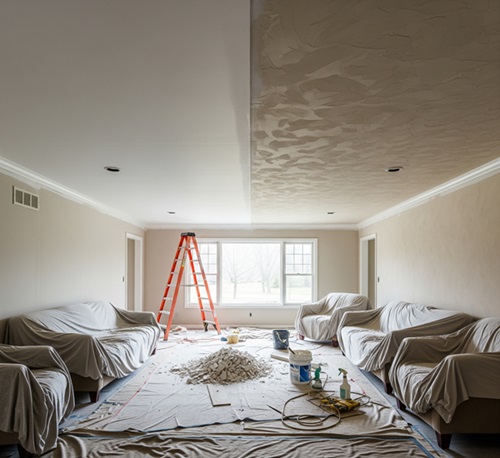
When damage covers most of the wall — large adhesive areas, dozens of anchor holes, mismatched textures, or unpainted sections — skim coating is faster than individual patching. **Skim coating process:** 1. **Address structural issues first.** Patch any holes larger than 1/4 inch and let them dry before skim coating. 2. **Prime the wall** with shellac or oil-based primer to seal any contamination and stabilize torn paper. 3. **Thin joint compound** to a pudding-like consistency. 4. **Apply with a 12 or 14 inch knife** in sections about 3 feet wide. Spread with the knife angled low, then knife off excess. 5. **First coat dries overnight.** Sand lightly with 120-grit. 6. **Second coat applied perpendicular to first.** Knife smooth in a single pass per section. 7. **Sand with 220-grit** after second coat dries. 8. **Inspect with raking light** to identify imperfections. 9. **Spot fill any flaws** with a third pass. 10. **Prime with PVA primer** before paint. **When to skim coat the whole room:** If one wall is being heavily skim coated and adjacent walls have minor damage or texture differences, skim coating the entire room produces a more uniform final appearance. Cost and time scale with wall area, but the result justifies the investment in most renovation projects.
Integrating the Repair With Surrounding Walls
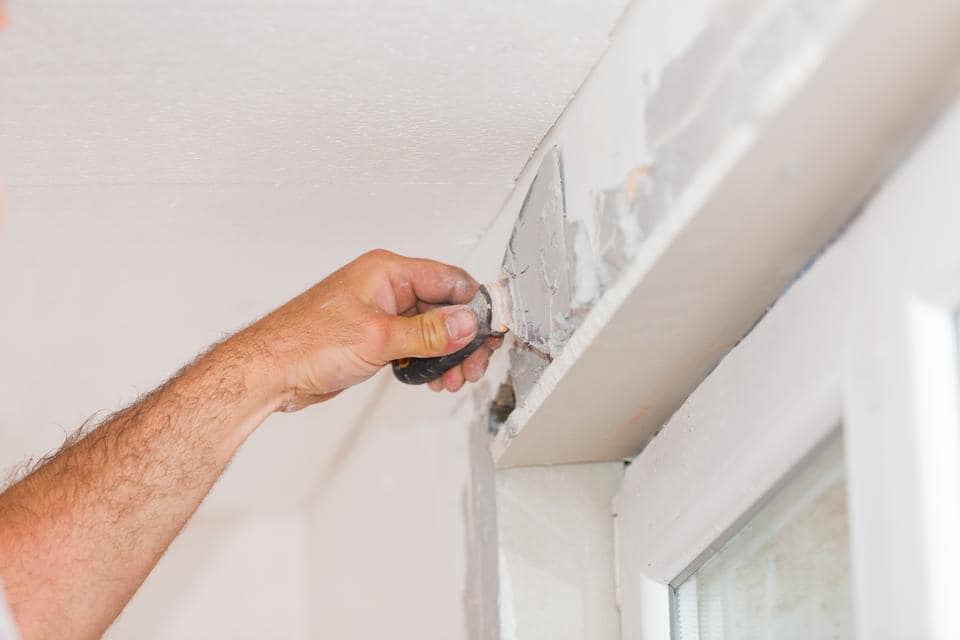
The final repair quality depends as much on integration with the surrounding walls as on the patches themselves. **Texture matching:** Match existing texture exactly. Most walls in modern homes have light orange peel or smooth finishes. Aerosol texture cans from any hardware store handle small areas; hopper sprayers are needed for larger projects. **Paint planning:** - **Single-wall repaints** work when the existing wall has a clean break at corners and the paint is recent and undamaged elsewhere. - **Full-room repaints** are usually required when the existing paint is faded, walls are interconnected at corners without clean breaks, or the room has many small patches. - **Trim and molding** should be touched up or repainted at the same time as the wall. **Trim reinstallation:** If baseboards or crown molding came off during cabinet removal, install new wherever possible — old trim rarely fits cleanly back into modified openings. **Final inspection:** View the completed wall under all lighting conditions: morning light, afternoon light, evening lamp light. Imperfections that didn't show during the day often become visible at night. Touch up before declaring the project complete. For whole-room cabinet removal projects, our <a href="/services/drywall-repair">drywall repair specialists</a> coordinate with kitchen and remodeling contractors to deliver paint-ready walls on schedule. Call (818) 918-2397 for a free estimate.
Need Professional Drywall Help?
Contact Fast Fix Drywall Repair for a free estimate on your next project.
Get a Free QuoteLooking for drywall repair services in your area? Browse our full service directory by city.