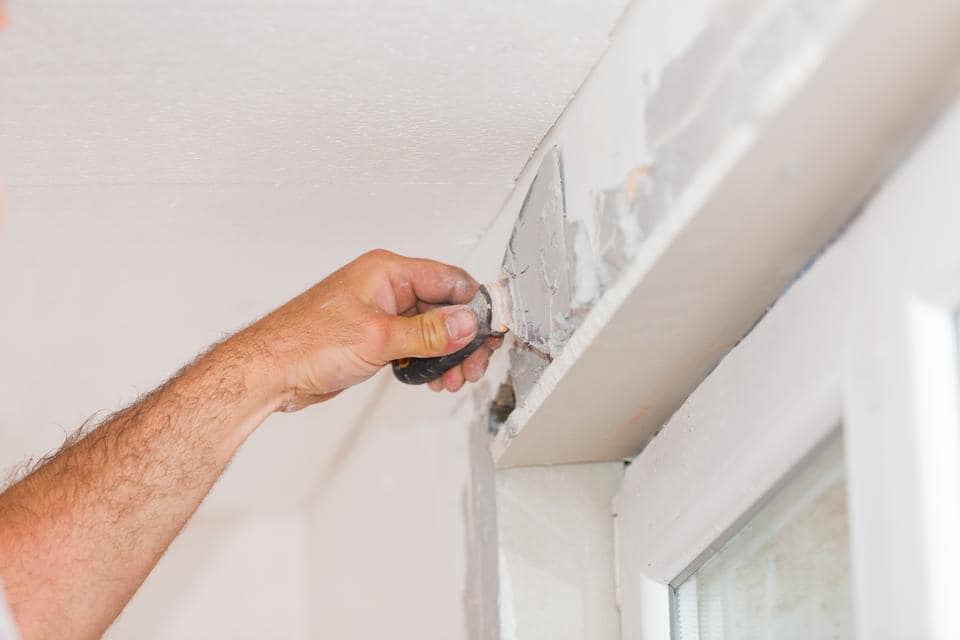
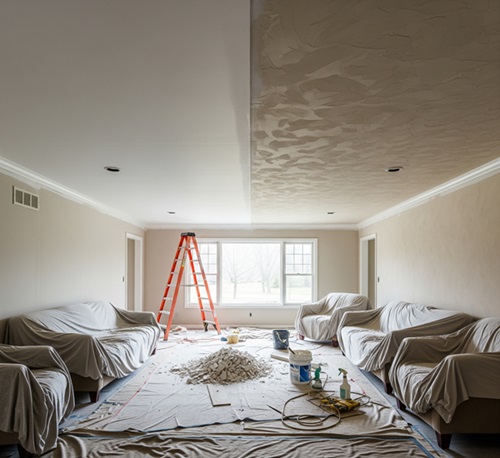
Recessed lighting projects often leave oversized or jagged holes in drywall. This guide shows you how to resize, patch, and finish those openings for professional, lasting results.
Why Recessed Lighting Causes Drywall Damage
Recessed lighting is one of the most popular upgrades homeowners make, but it almost always leaves drywall damage in its wake. Whether the original installer cut the hole slightly too large, the can light was repositioned, or you're replacing 6-inch cans with smaller 4-inch LED retrofits, you're left with ceiling drywall that needs careful repair before it looks finished again. Unlike wall repairs, ceiling drywall work brings extra challenges: gravity works against you, joint compound wants to sag, and any imperfection is highlighted by the very lighting you just installed. Done poorly, even a small patch around a recessed can will show as a shadow or texture mismatch every evening when the lights come on. Whether you're updating a kitchen in <a href="/locations/california/san-diego">San Diego</a> or finishing a basement remodel in <a href="/locations/michigan/detroit">Detroit</a>, our <a href="/services/drywall-repair">professional drywall repair</a> team understands exactly how to make ceiling patches around lighting disappear.
Common Scenarios That Require Repair Around Recessed Lights
There are five typical situations where you'll need to repair drywall around a recessed fixture: **1. Oversized rough cuts.** The installer used a hole saw or jigsaw and ended up with a hole that's noticeably larger than the can's trim ring. Standard trim covers about 1/4 inch of overcut — anything more shows. **2. Switching from cans to canless LEDs.** Modern slim LED disc lights have smaller diameters and different trim profiles, leaving a ring of exposed drywall (or worse, the old can frame). **3. Relocating a fixture.** You moved a recessed light by a few inches and now have a perfectly round hole in the wrong spot. **4. Removing recessed lighting entirely.** Going back to a flush ceiling means filling a 4–6 inch round hole — a real patch job, not a quick fill. **5. Damage from removing trim rings.** Removing old halo trims often tears the paper face of the drywall around the opening, leaving feathered, fuzzy edges that won't accept new trim cleanly. Each scenario calls for a slightly different approach. Homeowners in <a href="/locations/texas/austin">Austin</a> and <a href="/locations/florida/tampa">Tampa</a> frequently call us after lighting contractors leave these issues behind.
Step-by-Step: Patching an Oversized Recessed Light Hole
When the hole is just slightly too large for the trim, you have two options: shim the can with mounting brackets, or rebuild the drywall edge. The rebuild method gives a cleaner long-term result. **Materials needed:** - 90-minute setting-type joint compound (Easy Sand 90 or equivalent) - Mesh drywall tape - 4-inch and 8-inch drywall knives - 120-grit sanding sponge - Ceiling-matched primer and paint **Process:** 1. **Turn off power at the breaker** and remove the trim ring and bulb. 2. **Cover the can opening** with painter's tape and plastic to keep compound out of the fixture housing. 3. **Cut a strip of mesh tape** and wrap it around the inside of the opening so half of the mesh extends past the drywall edge into the gap. 4. **Mix setting-type compound** to a stiff peanut-butter consistency — regular joint compound sags too much on ceilings for an edge buildup. 5. **Build the edge inward** in two or three passes, letting each set up for 30–45 minutes before adding the next layer. 6. **Once the opening is sized to match the trim**, feather a thin skim coat across the surrounding ceiling. 7. **Sand, prime, and paint.** Reinstall the trim ring last so it sits perfectly flush against the rebuilt edge. Setting-type compound is non-negotiable for this work — premixed all-purpose compound dries too slowly overhead and will droop into the fixture.
Filling a Round Hole When Removing a Recessed Light
When you're removing recessed lighting altogether — say, switching to flush-mount fixtures or going dark in that area — you have a 4 to 6 inch round hole to deal with. This is a full structural patch, not a fill. The California patch (also called a butterfly patch) works well here but needs adjustment for round openings. Most pros prefer cutting the hole square first. **Recommended method:** 1. **Remove the entire fixture housing**, including any mounting brackets and electrical box (cap the wires properly per code and consult an electrician if needed). 2. **Square off the round opening** by drawing a square around the hole and cutting clean lines with a drywall saw. 3. **Add wood backing** — slide 1x3 furring strips behind the drywall on two opposite sides and screw them in place through the existing ceiling. 4. **Cut a square patch** from matching-thickness drywall (most ceilings are 1/2 inch, some are 5/8 inch — measure before buying). 5. **Screw the patch to the backing strips**, keeping it flush with the surrounding surface. 6. **Tape all four seams** with paper or mesh tape and apply three coats of joint compound, feathering each one wider. 7. **Match the existing ceiling texture** — popcorn, knockdown, or smooth — before priming. Ceiling patches are unforgiving because they're lit from across the room and viewed at an angle that highlights every flaw. If you're patching in a <a href="/locations/illinois/chicago">Chicago</a> condo or a <a href="/locations/georgia/atlanta">Atlanta</a> living room, take your time on the feathering — it's what separates an invisible patch from a visible one.
Matching Ceiling Texture After a Recessed Lighting Repair
Ceiling texture is the single biggest reason patches around recessed lights look obvious. Get the texture wrong and even a perfectly smooth patch will stand out under direct lighting. **Smooth (Level 5) ceilings:** These require a final skim coat over the entire patched area, followed by careful sanding and priming. Any roller stipple from the surrounding ceiling needs to be replicated by re-rolling the patch with the same nap roller. **Orange peel texture:** Use an aerosol orange peel texture can from any hardware store. Practice the spray pattern on a cardboard scrap first — distance, angle, and trigger pressure all affect droplet size. Let the spray dry, then prime and paint. **Knockdown texture:** Apply orange peel texture, wait 10–15 minutes until the peaks just begin to dry, then drag a wide knockdown knife lightly across the surface to flatten the tips. The timing is critical — too early and the texture smears, too late and the peaks won't compress. **Popcorn (acoustic) texture:** This is the trickiest. Aerosol popcorn texture exists but rarely matches existing texture perfectly. For high-visibility ceilings, many homeowners in <a href="/locations/arizona/phoenix">Phoenix</a> and <a href="/locations/nevada/las-vegas">Las Vegas</a> opt for full <a href="/services/drywall-finishing-texturing">professional finishing</a> rather than risk a mismatched patch. Whatever the texture, always prime before applying it. Raw joint compound absorbs texture material differently than primed surfaces, leading to inconsistent coverage.
When to Call a Professional for Recessed Lighting Drywall Work
DIY patches around recessed lighting are doable for handy homeowners, but several situations call for a pro: - **High or vaulted ceilings** where scaffolding or extension work is required. - **Multiple fixtures in one project** — a kitchen remodel with 12 recessed cans means 12 chances for visible patches. - **Textured or specialty ceiling finishes** where texture matching is hard to nail on the first try. - **Older homes with plaster ceilings**, where what looks like drywall is actually plaster over lath and requires different repair techniques. - **Insurance or rental properties** where documentation and licensed work matter. Our <a href="/services/drywall-repair">drywall repair specialists</a> serve homeowners nationwide and bring the right materials, tools, and texture-matching expertise to every recessed lighting project. Call (818) 918-2397 or email info@fastfixdrywallrepair.com for a free estimate on your ceiling repair.
Need Professional Drywall Help?
Contact Fast Fix Drywall Repair for a free estimate on your next project.
Get a Free QuoteLooking for drywall repair services in your area? Browse our full service directory by city.