Bathrooms and laundry rooms challenge drywall with constant humidity and splash exposure. Learn how to repair and refinish these spaces with materials and methods that resist moisture damage long-term.
Why Bathrooms and Laundry Rooms Destroy Standard Drywall
Standard drywall is a paper-faced gypsum panel designed for dry interior spaces. Put it in a room that hits 80% humidity daily for years on end, and it will eventually fail. The paper face absorbs moisture, the gypsum core softens, and mold finds an ideal food source. Add direct splashes from a shower, a leaky washer hookup, or a sweating toilet tank, and the failure timeline accelerates from years to months. The right answer isn't always full demolition. Many high-humidity drywall failures can be repaired using moisture-resistant materials, proper sealing, and ventilation improvements. But the wrong answer — patching with standard drywall and painting over the problem — guarantees the failure will return. From coastal humidity in <a href="/locations/florida/fort-lauderdale">Fort Lauderdale</a> to year-round indoor moisture in <a href="/locations/louisiana/baton-rouge">Baton Rouge</a> homes, our <a href="/services/water-damage-repair">moisture-resistant drywall repair</a> team uses the right materials and methods for each environment.
Identifying the Source: Humidity vs. Direct Water Exposure
Diagnosing the moisture source determines the repair approach. **Humidity-driven damage** shows up as: - Gradual paint peeling or bubbling, especially on ceilings - Soft, fuzzy mold spots in upper corners and behind toilets - Slight wall warping or wavy texture - Musty smell that intensifies after showers **Direct water damage** shows up as: - Localized stains beneath shower fixtures or behind sinks - Sharp-edged areas of softening rather than gradual - Bubbled paint with clear running patterns from drips - Visible drips or dampness on baseboards **Combination damage** is the most common — chronic high humidity has weakened the drywall and then a small leak finished it off. These cases need broader repairs than just patching the wet spot. Before any repair, the underlying cause must be resolved. That means improving ventilation (running an exhaust fan rated for the room's cubic footage during and after every shower), fixing any active leaks, and addressing condensation issues like uninsulated cold water lines. Otherwise the repair will fail just like the original.
Choosing the Right Materials for High-Humidity Repairs
Standard white drywall has no business in a bathroom or laundry room. Use moisture-resistant board for all repairs in these spaces. **Material options, in order of moisture resistance:** 1. **Cement backer board** (HardieBacker, Durock, Wonderboard). Required behind tile in shower and tub surrounds. Fully waterproof when properly sealed. 2. **Glass-mat gypsum board** (DensShield, GP DensArmor Plus). No paper face, so no mold food. Highly water resistant. The current professional standard for bathrooms. 3. **Green board (moisture-resistant drywall).** Paper-faced gypsum with water-resistant additives. Acceptable for general bathroom walls but not for direct water exposure or behind tile. 4. **Purple board (Gold Bond XP or USG Mold Tough).** Enhanced moisture and mold resistance. Better than green board for laundry rooms and humid bathrooms. 5. **Standard drywall.** Not appropriate for repairs in bathrooms or laundry rooms regardless of location in the room. For non-tile bathroom and laundry walls, glass-mat or purple board is the right choice. For tile areas, cement backer is mandatory. Use mold-resistant joint compound (USG Sheetrock Mold Tough, ProForm Mold Tough) for all taping and finishing in these rooms. The cost difference is minimal and the long-term benefit is substantial.
Step-by-Step Repair for Bathroom Wall Damage
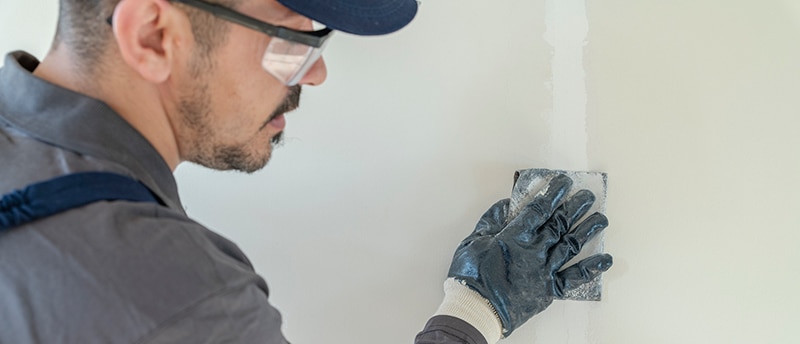
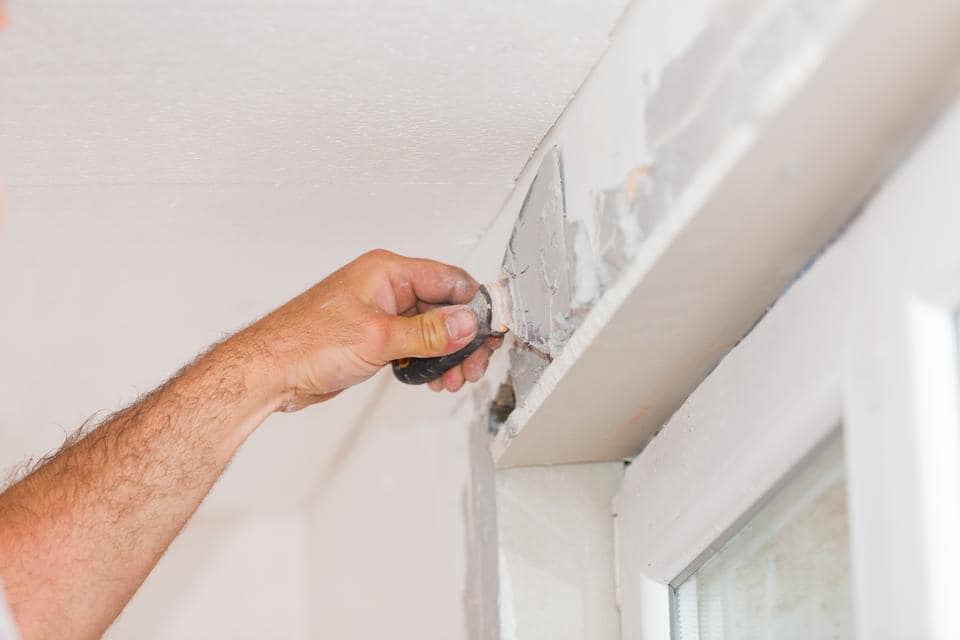
Here's the process for a typical bathroom wall repair where humidity has caused localized failure: **1. Remove all damaged material.** Cut back to solid drywall using a utility knife or oscillating multi-tool. Don't try to save marginal material — water-damaged drywall continues to fail. **2. Inspect the cavity.** Check insulation for moisture, framing for rot or mold, and any plumbing in the wall for leaks. Address all problems before closing up. **3. Treat the framing.** Wipe down any visible mold with a 10% bleach solution. Apply mold-killing primer to all exposed framing. **4. Cut moisture-resistant drywall to fit.** Match the existing wall thickness (usually 1/2 inch in bathrooms). Leave a 1/8 inch gap around the perimeter for movement. **5. Install with mold-resistant screws.** Use coated drywall screws every 12 inches on field and 8 inches on edges. Don't break the paper face. **6. Tape with mesh and mold-resistant compound.** Apply paper tape over the seams (paper holds up to compound stress better than mesh) with setting-type compound. Three coats: first to embed, second to fill, third to feather. **7. Sand smooth.** Use 120-grit then 220-grit sponges. Wipe down with a damp rag to remove dust. **8. Prime with stain-blocking, mold-inhibiting primer.** Zinsser Perma-White, Kilz Mold and Mildew Primer, or Sherwin-Williams Loxon are good choices. **9. Paint with bathroom-grade paint.** Use a satin or semi-gloss paint formulated for high-humidity spaces. Flat paint absorbs moisture and won't hold up in bathrooms.
Ventilation and Sealing: The Hidden Half of the Repair
Even the best materials will fail if humidity isn't controlled. Every bathroom and laundry room repair should include an evaluation of ventilation and moisture management. **Bathroom ventilation requirements:** - **Fan capacity:** 1 CFM per square foot of floor area, minimum. A 50 square foot bathroom needs at least a 50 CFM fan. - **Fan operation:** Run during showers and for at least 20 minutes after. Timer switches or humidity-sensing switches automate this. - **Duct routing:** Vent to the outside, never into an attic. Improperly vented fans dump moisture directly above the ceiling and rot the framing. **Laundry room considerations:** - Dryer vent connections must be tight and lint-free to prevent moisture leakage into the room. - Washing machine hookups should be regularly inspected for slow leaks at the supply connections. - Front-loading washers benefit from leaving the door cracked open between loads to dry the gasket. **Sealing details:** - Caulk around tubs, showers, sinks, and toilets to prevent water migration into wall cavities. - Use silicone caulk (not latex) at all wet locations — silicone resists mold and stays flexible. - Inspect and reseal caulk lines annually. These small details often prevent the next repair entirely. Customers in <a href="/locations/texas/san-antonio">San Antonio</a> and <a href="/locations/arizona/tucson">Tucson</a> see dramatic differences after addressing ventilation alongside the drywall work.
When to Call a Professional for Bathroom Drywall Work
DIY bathroom drywall repair is reasonable for small, isolated damage when the cause is clear and you have the right materials. Call a professional when: - **The damage extends behind tile.** Tile demolition is its own skill set and damage often reveals further issues underneath. - **You suspect or find mold.** Professional remediation may be required for safe removal, especially for areas over 10 square feet. - **Multiple walls are involved.** Whole-room repairs in tight bathrooms are difficult to do well without experience. - **Plumbing modifications are needed.** Coordinating drywall work with plumbing repairs is much smoother with a contractor experienced in both trades. - **The home is being prepared for sale.** Visible patches in bathrooms can dramatically affect appraisals. Our <a href="/services/water-damage-repair">moisture damage specialists</a> handle bathroom and laundry room repairs with the right materials, ventilation upgrades, and finishing techniques to deliver lasting results. Call (818) 918-2397 or email info@fastfixdrywallrepair.com for a free assessment.
Need Professional Drywall Help?
Contact Fast Fix Drywall Repair for a free estimate on your next project.
Get a Free QuoteLooking for drywall repair services in your area? Browse our full service directory by city.