Tiny homes and accessory dwelling units present unique drywall repair challenges from chassis movement to compact working spaces. Here's what works and what to avoid.
Why Tiny Homes and ADUs Damage Drywall Differently
Tiny homes and accessory dwelling units (ADUs) have exploded in popularity as housing affordability tightens and homeowners seek rental income, multigenerational living, or downsized lifestyles. But these small structures present drywall challenges that don't exist in conventional homes. **Tiny homes on wheels** experience constant micro-movement from road vibration, leveling on uneven ground, and structural flex during transport. This produces hairline cracks at every drywall seam within the first few years. **Backyard ADUs** are often built on simpler foundations than the main house — sometimes pier-and-beam or even slab-on-grade with minimal grade beams — making them prone to differential settling that cracks drywall around windows and door openings. **Converted garage ADUs** inherit all the issues of the original garage (settling slab, less robust framing) plus new drywall installed by remodelers who may not have used proper techniques for the existing structure. In ADU-friendly markets like <a href="/locations/california/los-angeles">Los Angeles</a>, <a href="/locations/oregon/portland">Portland</a>, and <a href="/locations/washington/seattle">Seattle</a>, we get more ADU drywall calls every year as the building stock matures.
Working in Tight Quarters
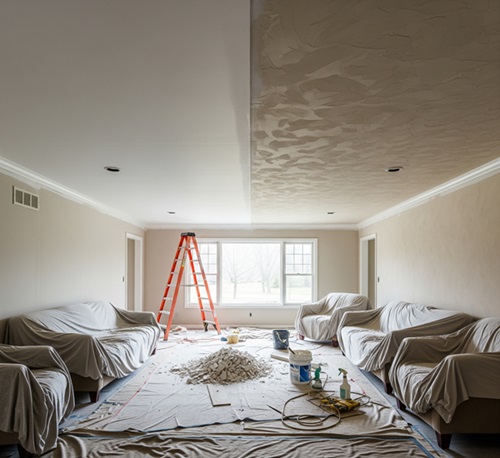
Tiny home and ADU drywall repair is physically harder than working in standard homes, simply because there's less room to swing a tool, set up a ladder, or stage materials. Pre-planning the repair makes a huge difference. **Practical strategies:** - **Bring everything in at once.** No room to make repeated material runs — load the space with all compound, tape, tools, and finishes before starting. - **Use compact tools.** A 4-inch and 8-inch knife instead of 6 and 12. A small mud pan instead of a hawk. A handheld pole sander instead of a full extension model. - **Cover everything.** Drop cloths over every horizontal surface, since dust travels nowhere in a small space. - **Plan ventilation.** Open windows and use a small fan to exhaust dust outdoors. Indoor air quality degrades fast in 200 square feet. - **Work in stages.** Don't try to mud, sand, prime, and paint in one session. The dust from sanding will ruin fresh primer or paint. These small-space considerations are part of why many tiny home and ADU owners hire professional drywall repair rather than attempting DIY — the cost savings of doing it yourself can disappear in cleanup time and rework.
Repairing Movement Cracks in Tiny Homes
Tiny homes on wheels are essentially structures riding on a trailer chassis, which means they flex slightly all the time. Standard rigid joint compound cracks at every seam within 1–3 years. The solution is to use flexible materials and techniques designed for movement. **Best practices for tiny home seam repair:** 1. **Remove cracked compound** with a utility knife, cleaning back to sound material. 2. **Use paper tape, never mesh.** Paper tape is much stronger in tension and resists cracking from movement. 3. **Use setting-type compound for the bed coat.** Setting-type compounds cure chemically rather than drying, creating a harder, more crack-resistant base layer. 4. **Apply finish coats with all-purpose or topping compound** — these sand smoother for a clean finish. 5. **Consider elastomeric finishing products** for very high-movement seams (corner cracks, ceiling-to-wall transitions). Products like Sheetrock Brand Sheetrock Flex are designed for this. 6. **Use flexible caulk for inside corners** instead of taping them rigidly. Paintable acrylic caulk handles ongoing movement without cracking. This flexible repair approach extends the useful life of your finishes significantly. We've worked on tiny homes in <a href="/locations/colorado/denver">Denver</a>, <a href="/locations/texas/austin">Austin</a>, and along the West Coast where mobile life puts drywall under constant stress.
Settling Cracks in ADUs
Backyard ADUs and garage conversions often settle differently than the main house, especially in the first two to five years after construction. This produces predictable crack patterns: - **Diagonal cracks from window and door corners** indicate foundation movement. - **Vertical cracks along wall-to-ceiling joints** suggest the building is racking slightly. - **Stair-step cracks across multiple panels** point to differential settling underneath. **Diagnostic step:** Before repair, mark the end of each crack with painter's tape and a date. Check in 30, 60, and 90 days. If the cracks keep extending, the foundation needs evaluation by a structural engineer before any cosmetic repair will hold. **For stable, non-growing cracks:** 1. Score the crack with a utility knife. 2. Apply paper tape bedded in joint compound. 3. Apply three feathered coats. 4. Sand, prime, and paint. **For active or recurring cracks:** Use a flexible caulking technique — fill the crack with paintable acrylic caulk, smooth it with a damp finger, prime, and paint. The caulk flexes with future movement without cracking. This is a cosmetic-only fix; the underlying movement still needs addressing. ADU owners in <a href="/locations/california/san-diego">San Diego</a> and <a href="/locations/florida/orlando">Orlando</a> often see initial settlement cracks resolve within two years; persistent cracks usually indicate a real structural issue.
Compact Plumbing and Electrical Penetrations
Tiny homes and ADUs pack a lot of plumbing and electrical into very little wall space. When repairs are needed — say, a plumbing leak inside a wall or an electrical change — the resulting drywall openings need careful patching. The challenge is that wall cavities in compact dwellings are often shallower than standard 2x4 construction. Some tiny homes use 2x3 framing or even 2x2 framing to save space, and the drywall behind plumbing or electrical work may have very little room to work with. **Patching tips for compact wall cavities:** - **Use thinner drywall if needed.** 3/8 inch drywall is acceptable for non-structural patches and may fit better in tight cavities than standard 1/2 inch. - **Use the California patch method** for small access holes — it doesn't require backing strips that may not fit. - **Tape and mud seams flexibly** to handle ongoing utility vibration (water hammer, HVAC, etc.). - **Avoid bulky repair materials** in cavities where they could interfere with utilities. For major repairs that require opening a substantial wall area, consider whether it makes sense to install access panels for future serviceability. In a tiny home, an inconspicuous 12x12 inch access panel near plumbing or electrical can save dozens of hours of drywall work over the building's life.
Finishing Considerations for Small Spaces
Small spaces show every imperfection. With walls only a few feet from the viewer, what passes for a smooth finish in a standard home looks rough in a tiny home. Plan for higher finish standards on small dwellings. **Finish level recommendations:** - **Level 5 finish** (full skim coat) for any wall the occupant will see up close — bedroom walls, living area walls, anywhere a chair backs against a wall. - **Level 4 finish** (three coats over tape and fasteners, smooth) is acceptable for storage areas, closets, and behind built-in furniture. - **Eggshell or satin paint** rather than flat, since these sheens hide minor surface texture better when light rakes across the wall. - **Consider darker or warmer colors** that absorb light rather than highlight texture. Pure white walls under direct LED lighting reveal every flaw. For tiny home owners and ADU landlords who want professional-quality finishes that survive years of use, our <a href="/services/drywall-finishing-texturing">drywall finishing</a> team specializes in the high-standard work that compact spaces require. Whether your project is in <a href="/locations/oregon/portland">Portland</a> or <a href="/locations/washington/seattle">Seattle</a>, we deliver finishes that look great even at arm's length.
Need Professional Drywall Help?
Contact Fast Fix Drywall Repair for a free estimate on your next project.
Get a Free QuoteLooking for drywall repair services in your area? Browse our full service directory by city.