Window AC units leave behind moisture damage, sagging drywall, and mounting bracket holes. Here's how to repair the damage and prevent recurrence.
How Window ACs Damage Drywall
Window air conditioners are cheap, effective, and incredibly hard on the drywall and trim around them. The damage comes from four sources: condensation drips, structural weight, mounting hardware, and air leakage that allows humid outside air to condense inside the wall cavity. A window AC running for a single summer in a humid climate can stain or soften the drywall directly beneath the unit. Over multiple seasons, the cumulative damage often includes: - Water stains and mold on the wall below the unit - Sagging drywall where condensate ran behind the trim - Mounting bracket holes in the window frame and adjacent wall - Cracked drywall where the unit's weight stressed the window opening - Peeling paint from chronic moisture exposure In humid markets like <a href="/locations/florida/miami">Miami</a>, <a href="/locations/louisiana/new-orleans">New Orleans</a>, and <a href="/locations/texas/houston">Houston</a>, post-AC drywall repair is one of the most common service calls we get every fall when units come out for the season.
Inspecting the Damage After AC Removal
Before any repair, do a thorough inspection. Window AC damage often extends beyond what's visible from the room side. **Check these areas:** 1. **The wall directly below the unit.** Look for water staining, soft spots, paint peeling, or visible mold. 2. **The window stool and apron.** Wood trim under the AC may be rotted, swollen, or cracked. 3. **The drywall on either side of the window opening.** Mounting brackets can pull the drywall outward or crack it. 4. **The wall cavity itself.** If possible, look behind the trim or remove a section of baseboard to inspect for hidden moisture damage. 5. **The exterior side of the wall.** Outside, look for staining or sealant failure where the unit was mounted. Use a moisture meter on any suspicious areas. Drywall above 1% moisture content is suspect and may need replacement rather than just refinishing. If you find mold, address it with proper PPE and containment before doing any cosmetic repair — sealing mold inside a finished wall just delays a much bigger problem.
Repairing Surface Water Damage and Stains
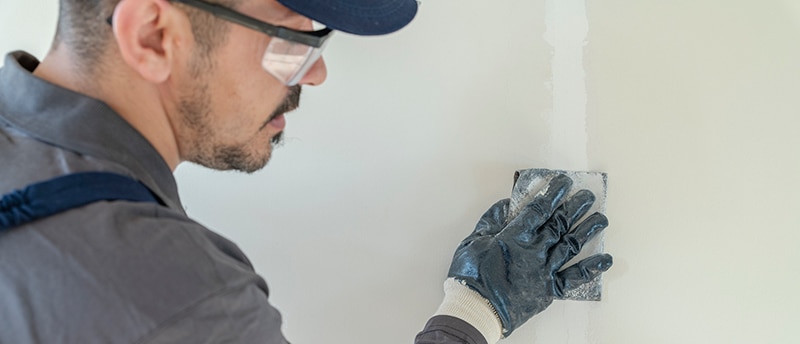
For light surface damage where the drywall is still firm and dry, the repair is straightforward: **Materials needed:** - Stain-blocking primer (oil-based or shellac-based) - 120-grit sanding sponge - Joint compound for any surface imperfections - Wall paint matching the room **Process:** 1. **Let the wall dry completely** — at least a week of low-humidity conditions after AC removal. 2. **Lightly sand any peeling paint** to feather the edges into the surrounding sound paint. 3. **Spot-fill any small surface imperfections** with lightweight spackle. Sand smooth. 4. **Apply stain-blocking primer to the entire damaged area.** Don't skip this step — water stains will bleed through latex paint and reappear within weeks. 5. **Let primer dry fully** (4–6 hours minimum for oil-based; check the can for specifics). 6. **Paint** the area to match. Often this requires painting the entire wall to avoid visible touch-up flashing. Stain-blocking primer is non-negotiable for water-damaged drywall. Latex primers won't seal water stains, and the stains will bleed through your finish coat within days.
Replacing Sagging or Damaged Drywall Sections
When the drywall is soft, sagging, or showing visible mold, surface repair isn't enough. The damaged section must be removed and replaced. **Step-by-step replacement:** 1. **Cut out the damaged area.** Mark a rectangle around the damage and cut along the lines with a drywall saw. Cut to expose at least one stud on each side for cleanest patching. 2. **Inspect the framing and insulation behind the wall.** Replace any wet insulation. Treat mildewed framing with a mold-killing solution and let dry. 3. **Add backing if needed.** If the cut doesn't fall on studs, install furring strips behind the existing drywall as backing. 4. **Cut a matching-thickness drywall patch** (typically 1/2 inch for interior walls). 5. **Screw the patch into the framing or backing strips.** 6. **Tape the seams** with paper or mesh tape. 7. **Apply three coats of joint compound**, feathering each one progressively wider. 8. **Sand smooth.** 9. **Prime with stain-blocking primer** and paint the wall. For coastal homes in <a href="/locations/florida/tampa">Tampa</a> or <a href="/locations/south-carolina/charleston">Charleston</a>, consider moisture-resistant drywall (green board or purple board) when replacing damaged sections near windows that will continue to have AC units installed seasonally.
Fixing Mounting Hardware Damage
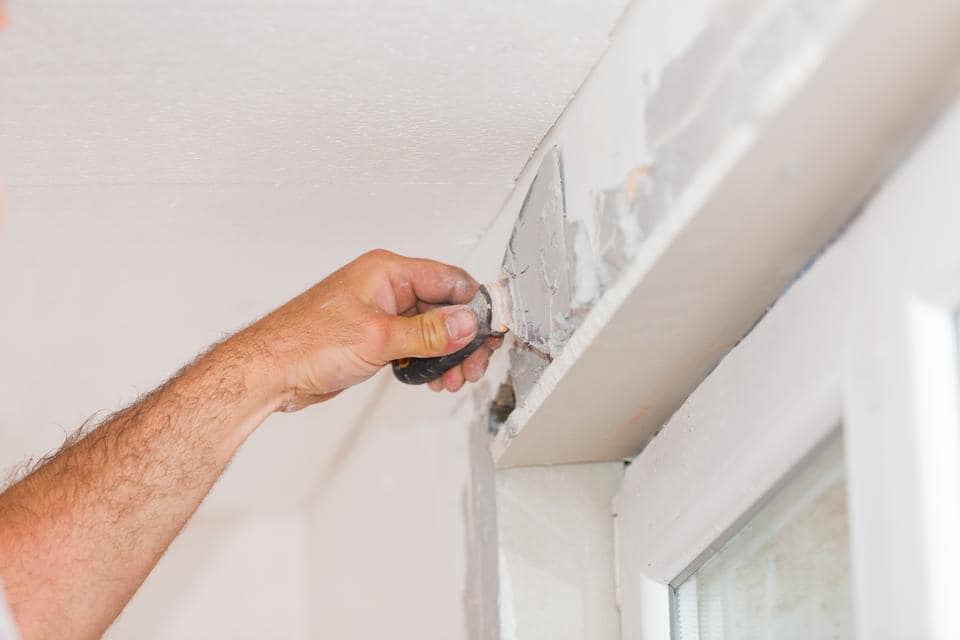
Window AC support brackets attach to the window sill, trim, and sometimes to studs through the drywall. Removing them often leaves multiple holes and damage: **Standard mounting hole repair:** 1. **Remove all anchors and screws.** Plastic anchors should pull out with needle-nose pliers. 2. **Fill each hole with lightweight spackle.** For larger holes (over 1/4 inch), use setting-type compound for strength. 3. **Sand flush** with the wall surface. 4. **Prime and paint** to match. **For damaged window trim:** Wooden window trim that's been compressed by AC support brackets often shows dents or splits. Minor dents can be filled with wood filler and sanded. Severe damage requires replacing the affected trim piece — usually the stool (interior windowsill) or apron (trim below the sill). **For cracked drywall around the window opening:** These cracks usually run from the corners of the window opening outward, caused by the AC's weight stressing the framing. Fix them with paper tape and three coats of joint compound, feathered widely. If cracks recur, the underlying issue is structural and should be evaluated by a contractor. Our <a href="/services/drywall-repair">repair specialists</a> in <a href="/locations/new-york/new-york-city">New York City</a>, <a href="/locations/illinois/chicago">Chicago</a>, and other window-AC-heavy markets handle these repairs every fall and spring.
Preventing Future Damage with Better Installation
If you're reinstalling a window AC for next season, take steps to prevent the damage from recurring: **Use a proper support bracket.** External wall-mounted brackets transfer the unit's weight to the building structure rather than the window itself. This eliminates frame stress and cracked drywall around the opening. **Tilt the unit correctly.** Window ACs should slope slightly downward toward the outside (about 1/4 inch over the unit depth) so condensate drains outdoors rather than indoors. **Seal all gaps.** Foam weatherstripping and removable caulk around the unit prevent humid outdoor air from infiltrating the wall cavity and condensing inside. **Use an AC drip pan.** A small plastic tray under the unit catches any condensation that does drip indoors, protecting the wall and trim below. **Consider alternative cooling.** Mini-split heat pumps and through-the-wall AC units eliminate window AC problems entirely. They cost more upfront but pay back in efficiency, comfort, and avoided drywall damage. For homeowners ready to retire their window units, we coordinate <a href="/services/drywall-repair">drywall repair</a> with HVAC installations to ensure clean transitions and finished results.
Need Professional Drywall Help?
Contact Fast Fix Drywall Repair for a free estimate on your next project.
Get a Free QuoteLooking for drywall repair services in your area? Browse our full service directory by city.