A flawless drywall patch means nothing if the texture does not match. Here is how professionals replicate orange peel, knockdown, and other common textures so repairs disappear.
Why Texture Matching Is the Hardest Part of Any Repair
You can cut a perfect patch, tape every seam flawlessly, and apply three coats of joint compound with surgical precision — but if the texture on the repaired area does not match the surrounding wall, the patch will be visible forever. Texture matching is part science, part art. The original texture was applied under specific conditions — a particular spray tip size, air pressure, compound consistency, distance from the wall, and ambient humidity — and replicating those exact conditions months or years later is inherently challenging. Even professional drywall finishers acknowledge that texture matching is one of the most difficult skills to master. The good news is that with the right tools, materials, and technique, it is possible to achieve a match that is virtually undetectable once painted.
Identifying Your Existing Texture Type
Before you can match a texture, you need to identify what you are trying to replicate. The most common residential textures in the United States include orange peel (a fine, uniform stipple that resembles the skin of an orange), knockdown (a splattered pattern that is flattened with a knife to create irregular islands), skip trowel (a hand-applied swooping pattern), smooth (no texture at all, just flat compound), and popcorn (a heavy, bumpy texture commonly found on ceilings). Each requires a different application method, tool set, and compound consistency. In [Phoenix](/locations/arizona/phoenix) and [Scottsdale](/locations/arizona/scottsdale), knockdown and orange peel are by far the most popular textures, driven in part by the region's Spanish-influenced architectural style. Homes in [Tucson](/locations/arizona/tucson) tend to favor heavier skip trowel textures that complement the Southwest aesthetic.
Tools and Materials for Texture Replication
For spray textures like orange peel and knockdown, you will need a hopper gun (also called a texture sprayer) connected to an air compressor. The hopper holds the thinned joint compound and atomizes it through an adjustable nozzle. Nozzle size, air pressure, and distance from the wall all affect the pattern. For small repairs, aerosol texture cans are a convenient alternative — they come pre-loaded with compound and produce a reasonable orange peel or knockdown pattern without the setup of a hopper system. For hand-applied textures like skip trowel, you need a curved drywall knife (12 to 14 inches) and a hawk to hold the compound. All-purpose pre-mixed joint compound works well for most textures, but for spray applications you will need to thin it with water to achieve a pourable consistency. Add water gradually — too thin and the compound will run; too thick and it will not atomize properly.
Applying Orange Peel Texture Step by Step
Thin your joint compound to a consistency slightly thicker than pancake batter. Load the hopper and set your compressor to 25–30 psi as a starting point. Hold the gun 18 to 24 inches from the wall and apply a light, even pass. The goal is small, uniform dots that do not run or sag. Practice on a piece of cardboard or scrap drywall first, adjusting the nozzle size and pressure until the dot size matches your existing wall. Apply the texture to the patched area and extend slightly (two to three inches) onto the surrounding texture to blend the transition. Allow the texture to dry completely before priming and painting. In [Mesa](/locations/arizona/mesa), the dry desert air accelerates drying time, so work in manageable sections to avoid the compound setting before you can adjust the pattern.
Replicating Knockdown Texture
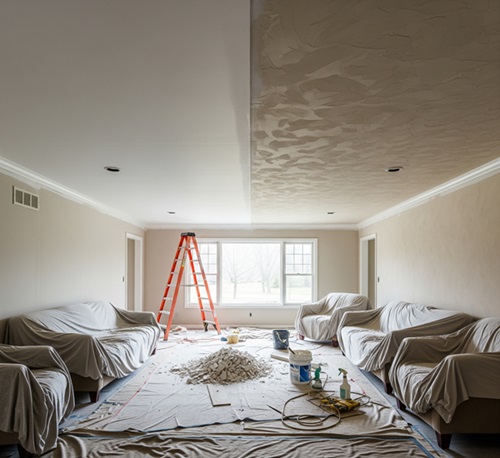
Knockdown starts the same way as orange peel — spray a pattern of compound dots onto the wall. However, the dots should be larger and more widely spaced than orange peel. After spraying, wait five to ten minutes for the compound to begin setting (it should be firm enough to hold its shape but still slightly damp), then lightly drag a wide drywall knife across the surface in long, overlapping strokes. This flattens the tops of the dots and creates the characteristic irregular plateau pattern. The timing of the knockdown pass is critical — too soon and the compound smears flat, too late and the knife tears the dried compound. Our [drywall finishing and texturing](/services/drywall-finishing-texturing) professionals in [Chandler](/locations/arizona/chandler) and [Tempe](/locations/arizona/tempe) have years of experience timing this step perfectly for Arizona's arid climate.
Blending the Transition Between Old and New Texture
The transition zone — where new texture meets old — is where most amateur texture jobs fail. To create an invisible transition, always extend your new texture slightly beyond the patched area onto the existing texture. This overlap disguises the edge. After the new texture dries, sand the transition lightly with 150-grit sandpaper or a sanding sponge to soften any hard lines. Before painting, prime the entire area with a high-quality primer-sealer. Texture absorbs paint differently than the surrounding wall, so unprimed texture will show as a different sheen or color even with the same paint. Use a roller nap appropriate for your texture (3/8 inch for smooth or light texture, 1/2 to 3/4 inch for heavier textures) and apply paint in full-wall sections to ensure uniform coverage.
When Professional Texture Matching Is Worth the Investment
If your walls have an unusual or custom texture, or if the repaired area is in a highly visible location like an entryway or living room, hiring a professional for the texture matching stage is money well spent. A skilled finisher can replicate virtually any texture pattern and blend it seamlessly into the surrounding surface. Our team has matched textures in homes ranging from 1960s tract housing to custom desert estates across [Phoenix](/locations/arizona/phoenix) and the greater Valley area. We offer texture-match consultations where we examine your existing walls, prepare test samples, and confirm the match before applying the final texture to your repair.
Need Professional Drywall Help?
Contact Fast Fix Drywall Repair for a free estimate on your next project.
Get a Free QuoteLooking for drywall repair services in your area? Browse our full service directory by city.